Clarity is the Standard

There is a particular kind of sentence that appears professional, sounds careful, and yet collapses the moment you try to use it.
It often takes this form:
There may be exceptions… but not here.
At first glance, this sounds responsible. It gestures toward nuance. It signals awareness of complexity.
But when examined closely, it performs no instructional work at all.
In a recent educational slide intended for home inspectors, the language states that most services should be based on a written agreement, that there are “few, if any, exceptions,” and that the service being discussed is not among them.
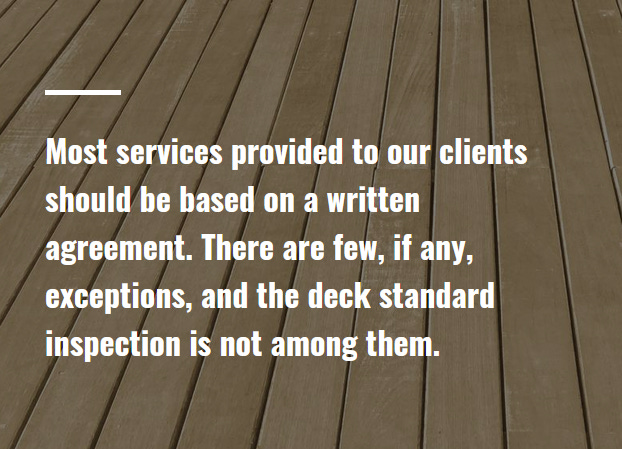
When that sentence is taken at face value, the meaning is simple:
All professional home inspection services provided by ASHI inspectors require a written agreement or contract.
That is the rule. Everything else is decoration.
To illustrate the problem more clearly, here is the kind of sentence that creates confusion:
I am taking a position against language that sounds authoritative while quietly undermining understanding. Language that asks inspectors to accept contradiction instead of clarity.
That sentence I just wrote sounds thoughtful. It is also evasive.
Here is what it should say instead:
Professional education should state requirements plainly, without implying discretion where none exists.
The difference matters.
When training materials introduce hypothetical exceptions that are immediately withdrawn, they teach inspectors to tolerate contradiction rather than resolve it. They suggest judgment while removing choice. They sound flexible while delivering absolutes.
This is inverted logic.
And in an educational setting, inverted logic is not harmless. Newer inspectors assume the confusion is theirs. Experienced inspectors recognize the problem but learn to ignore it. Over time, unclear language becomes normalized, and precision is treated as optional.
I am not against nuance.
I am not against professional judgment.
I am not against careful drafting.
I am for clarity where clarity already exists.
When a rule is absolute, it should be written as such.
When exceptions exist, they should be named.
When judgment is required, the boundaries of that judgment should be explained.
Professional education is where inspectors are prepared to act, decide, and document with confidence.
Clarity is the minimum standard.