The Double-Frog Brick Dilemma
Cheap Bricks? Phantom Risks? The Strange Case of Ambiguous Masonry

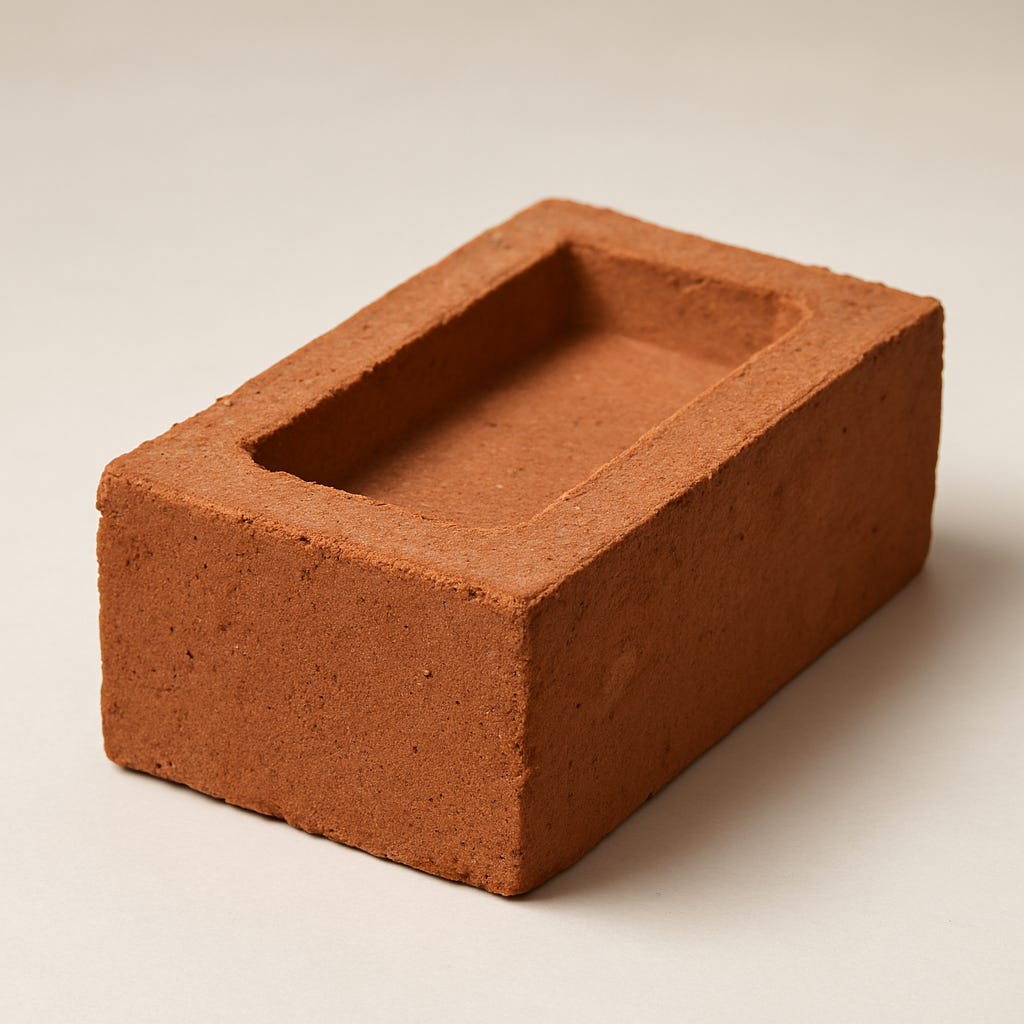
The Strange Case of Ambiguous Masonry
It started, as these things often do, with a question plucked from the void: What are the risks of laying bricks frog down, and how could this impact long-term building maintenance?
A reasonable enough question — until you realize the entire framing of “risk” collapses when you encounter the peculiar creature that is the double-frog brick: a brick with frogs on both its top and bottom faces. For anyone unfamiliar, a frog is the shallow depression molded into a brick’s bed face, historically intended to key mortar more effectively. In theory, laying a brick frog up lets gravity help fill the hollow with mortar, improving bond strength and reducing voids. Laying it frog down, on the other hand, forces the mason to butter the frog manually — a fiddly process that invites air pockets and weak joints.
But what happens when your brick has frogs on both sides?
The Confounding Choice: No Choice at All
In bricks with a frog only on one face, the mason has a clear decision: frog up. It’s straightforward, reliable, and leads to consistent bedding. But bricks with frogs on both faces strip away that clarity, offering no indication of which orientation is “correct.” You might think this eliminates second-guessing — after all, if either side could be up, isn’t there no wrong choice?
In practice, this leads to quiet chaos:
One mason might start laying frog up;
Another could lay them frog down without realizing;
Even the same mason might alternate unintentionally, depending on fatigue or lighting conditions.
Multiply that inconsistency across thousands of bricks, and you end up with a patchwork of bedding strength, void distribution, and moisture pathways — the real risk in this scenario.
The Economics of Double Frogs
So why would anyone manufacture or specify bricks with frogs on both faces? Theories abound:
Cheaper production?: Some old brick presses molded frogs on both sides as a quirk of their mechanical design, reducing sticking in molds and lowering reject rates, which in turn reduced costs.
Marketing spin?: Imagine a clever salesman declaring, “Our bricks key mortar from both directions for superior strength!” …never mind the practical impossibility of filling the underside frog properly during normal laying.
Perceived flexibility?: Dual frogs theoretically allow bricks to be laid either way, minimizing sorting and speeding up handling, which can shave a bit off labor time, or so the thinking goes.
But any upfront savings quickly vanish when you tally the extra mortar needed to fill two frogs, the fatigue from awkward troweling, and the long-term repairs stemming from inconsistent bonding. Mortar and labor are rarely cheaper than a well-made single-frog brick laid correctly.
Chasing the Real Risk
Here’s the truth:
The real risk isn’t the frog’s orientation.
It’s using a brick design that creates ambiguity, inconsistency, and additional work for the mason.
It’s choosing cheap materials over straightforward, reliable ones.
All the extra time spent filling frogs that shouldn’t exist, all the subtle structural weaknesses introduced by air pockets and moisture traps, all the future maintenance headaches. They’re the price paid for chasing a marginally cheaper brick.
Endless Questions, Few Answers
Why do ambiguous bricks persist?
Has anyone conducted a study comparing single- and double-frog brick performance in real-world walls?
Do architects know what they’re specifying when they tick the box for a double-frog brick?
Are building codes silent on the question because no one has ever thought it important enough to test?
These questions hang in the air, unanswered, like the empty frogs themselves, waiting to trap water, time, and money.
Conclusion:
The next time you hear someone throw the word “risk” around when discussing frog orientation, remember: the real risk isn’t the mason’s technique, but the bricks themselves. And maybe, just maybe, some clever marketing made a two-headed brick seem like a good idea.
Editor’s Note:
After a deep dive through brick manufacturers’ catalogs, masonry guides, and every dusty corner of the internet, it appears the elusive “double-frog brick” may exist more in theory than in reality. In fact, it’s entirely possible this author accidentally sparked a minor urban legend by suggesting such a brick could exist in the first place. If so, consider this the first official sighting of a myth in the making — and a reminder that sometimes, the best rabbit holes are the ones we dig ourselves.